What Changes When Data Stops Being About Reporting
The one question BI-mature organizations must answer before buying AI tools"

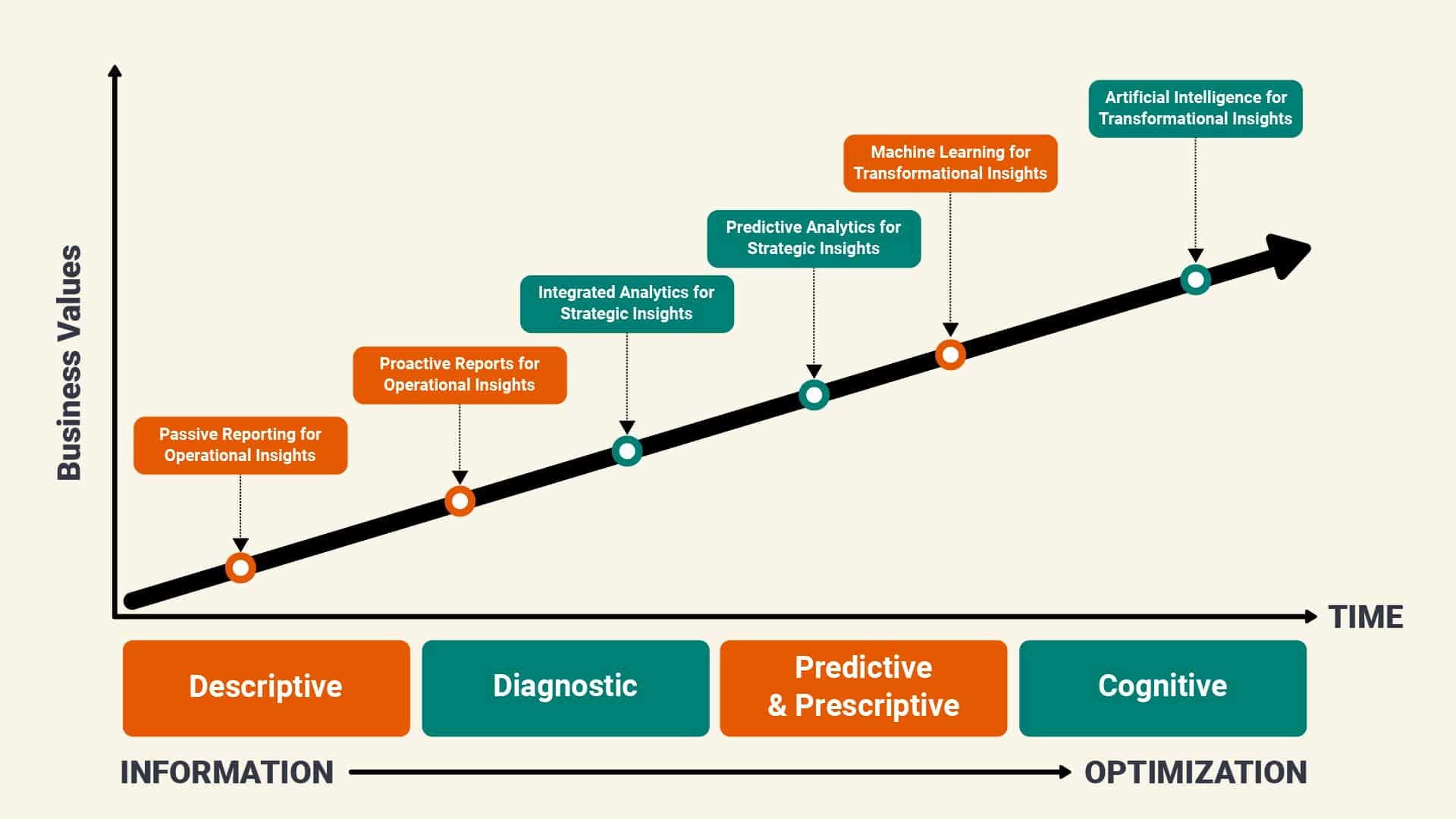
Analytics Maturity Model: The Journey towards Analytics Excellence
Most organizations trying to adopt AI in 2026 are starting in the “Wrong Place“.
Most Organizations treat AI like a technology upgrade, not an operating model change. As a result, they move quickly into execution without first deciding what AI is meant to change.
This “wrong place” shows up in very predictable ways:
Buying tools before defining the business problem.
Running AI pilots that produce insights, but do not change how or when decisions are made.
Treating AI like a feature to add, rather than a capability that changes how work gets done.
This is the same mistake organizations made early in BI journey, building dashboards before defining metrics and decision ownership. AI just makes the cost of that mistake higher.
“Why Starting With Tools Fails”
When organizations start with tools, they usually begin with vendor selection: platforms, LLMs, MLOps stacks, copilots, etc
The problem is simple: “tools cannot answer the most important questions”.
Tools cannot tell you:
What to predict
Which decisions matter
What success looks like
Who is responsible for acting on the output
“They start by asking how to ‘add AI’ to dashboards.”
Many teams then ask how to “add AI” to dashboards, assuming AI is a visualization enhancement.
But dashboards were built for:
Review
Monitoring
Explanation
AI is built for:
Early detection
Recommendation
Intervention
When you force AI into dashboards, you usually get:
Forecast lines that don’t change decisions
Insights that arrive after the window to act
“Interesting” predictions with no owner
At that point, AI becomes another reporting layer, super sophisticated, but not effective.
The Question That Changes Everything
All of this happens because one question is skipped:
What decision are we trying to improve before it is made?
A practical way to ask this is:
Which decision, if made 24–48 hours earlier or with one more data point, would change outcomes for the business?
Until that question is answered, AI efforts remain disconnected from impact.
This series is written for organizations with mature Business Intelligence that want to move beyond reporting and into prediction and decision systems without losing what made their BI valuable in the first place.
Your Current BI is not Holding You Back
Your current BI capability is not what’s holding you back. It is your starting advantage. Most organizations fail at AI because they assume BI is “outdated,” when actually BI provides the discipline AI needs.
For instance, most organizations believe BI is the problem, so they try to “replace” it with AI. This usually creates chaos such as inconsistent definitions, models that are not governed, etc. The real issue is not about the quality of your BI, but the purpose it is serving.
How can AI create Value Differently?
AI only creates value when it changes what happens next.
That does not mean “better insights.”
It means earlier or different decisions.
If a prediction does not cause the organization to act sooner, focus attention differently, or intervene before an outcome is locked in, it has no business value. It is simply an additional analysis.
so here is what I mean,
A model can predict churn accurately, but if customers are still reviewed at the same monthly cadence, nothing changes. A model can forecast revenue risk, but if planning decisions still happen at quarter-end, the prediction arrives too late to matter. In these cases, AI did not fail technically, it failed operationally.
The test is simple:
If the AI output disappeared tomorrow, would any decision be made differently?
If the answer is no, the AI is not creating value.
This is why dashboards alone are not enough. Dashboards support review. They assume someone will notice a change, interpret it, and decide what to do. AI must support intervention. It must be connected to a moment where action can still alter the outcome.
What Actually Changes When Data Stops Being About Reporting
This is the shift many organizations struggle with.
When data is about reporting, success looks like accurate numbers and clear explanations of past performance. But when data becomes about decisions, success looks like faster response and changed outcomes.
Nothing about your BI capability becomes irrelevant. Your metrics, definitions, and governance still matter but they no longer stop at description. They have to support prediction and action.
This series exists to unpack that shift not from the perspective of AI tools or hype, but from the reality of organizations that already know how to report well and now need to understand what changes when data is no longer just describing the past.
What’s Next in This Series
Why Clean Dashboards Still Produce Bad AI (And What Data You Actually Need)
This is where many BI-mature organizations become uncomfortable, as the data used for reporting is often the wrong data for prediction.
Quick Check: Is Your Organization Ready? Answer these three questions:
1. Can you name a specific decision that would change if you had a signal 24-48 hours earlier?
2. Is there a person/team responsible for acting on that signal when it arrives?
3. Do you have a way to measure whether acting earlier actually changed the outcome?
If you answered "no" to any of these, you're not ready for AI tools yet. You're ready for decision design.
This is an excellent article. Thank you for highlighting the issue that so many leaders overlook: "Why on earth are they thinking about even using AI in the first place?" rather than just starting to build the various dashboards and widgets that can accompany it? I wish more people in business were thinking about this with such clarity.
Amazing and well written article. Lovely to pick your mind on this prevalent topics